
According to the global business information, knowledge and insight provider, India is likely to achieve an average growth rate of around 7.5 per cent during FY15-FY20.

If the fiscal deficit for the year can be maintained at Rs 7.04 trillion, the deficit as a percentage of GDP will slip to 3.44 per cent

Public investment is very crucial for GDP growth, says finance ministry.

Armed with necessary macro and micro growth drivers, India is on its way to becoming the fastest growing major economy in the world, a finance ministry report said. Rapid vaccination and teeming festivities will push India's ongoing recovery resulting in narrowing of demand-supply mismatches and greater employment opportunities, as per the monthly Economic Review prepared by the ministry.

Manufacturing sector activities in India moderated in June from a 31-month high in May, but output remained in the growth territory, as new work orders expanded sharply amid favourable demand conditions, a monthly survey said on Monday. The seasonally adjusted S&P Global India Manufacturing Purchasing Managers' Index (PMI) fell from 58.7 in May to 57.8 in June. Despite the fall, the headline figure pointed to a considerable improvement in operating conditions, the survey said, adding that the demand strength positively impacted several other measures such as sales, production, stock building and employment.

Finance Minister Nirmala Sitharaman on Wednesday raised the personal income tax rebate limit, doled out sops on small savings and announced one of the biggest hikes in capital spending in the past decade as she did a tight rope walk in the Budget between staying fiscally prudent and meeting public expectations in the year before general elections.
India's economy, estimated to contract by 6.9 per cent in 2020 due to the coronavirus pandemic, is forecast to record a "stronger recovery" in 2021 and grow by 5 per cent, according to a UN report which said the country's current fiscal year budget points to a shift towards demand-side stimulus, with an uptick in public investment. The report, 'Out of the frying pan ...Into the fire?' published Thursday as an update to the Trade and Development Report 2020 by UN Conference on Trade and Development (UNCTAD) said the global economy is set to grow by 4.7 per cent this year, faster than the 4.3 per cent predicted in September 2020, thanks in part to a stronger recovery in the US, where progress in distributing vaccines and a fresh fiscal stimulus of $1.9 trillion are expected to boost consumer spending.

While the US-Iran conflict leading to a spike in global oil prices and trade war between the US and the EU topped the chart with 25 per cent, other major risks to the global economy include coronavirus, debt burdens causing a recess across emerging markets and Hong Kong protests causing an exodus from Asia's biggest financial centre.

Supported by slightly stronger global growth, improving export competitiveness and implementation of recently approved investment projects, India's growth is expected to recover from 4.4 per cent in 2013 to 5.4 per cent in 2014, the IMF said.

Equity benchmarks extended their decline for the fourth straight session on Wednesday, with the Sensex falling 214.85 points after the Reserve Bank raised the key interest rate by 50 basis points. Continuous foreign fund outflows and surging crude oil prices also weighed on markets. The 30-share BSE benchmark dropped 214.85 points or 0.39 per cent to settle at 54,892.49.

India will see a gradual growth acceleration with its GDP expected to reach 5.9 per cent this year.

Leading economists have pencilled in a high 13-15.7 per cent uptick in the economy in the first quarter of 2022-23 with an upward bias. Soumya Kanti Ghosh, the group chief economic adviser at State Bank of India, on Tuesday said he expects the GDP to clip past 15.7 per cent in the first quarter with more chances of the final numbers printing in higher, while Aditi Nayar, the chief economist at the rating agency Icra, said the economy will grow much lower at 13 per cent in the June quarter. The national statistical office will announce the first quarter GDP numbers later next week.
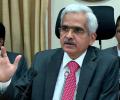
While efforts are being mounted on a war footing to arrest its spread, COVID-19 will impact economic activity in India directly through domestic lockdown. The second-round effects, it said, would operate through a severe slowdown in global trade and growth.

'India is in a slowdown which most of us have not seen in our living memory.'
RBI in wait and watch mode as several risks to inflation continue to exist including a sudden reversal of food prices and oil price volatility.

India is in favourable position to attract foreign firms planning to relocate their manufacturing bases due to trade tension between the US and China, says Nomura.

Pegging the cost of the covid-19 lockdown at USD 120 billion (approximately Rs 9 lakh crores) or 4 per cent of the GDP, analysts on Wednesday sharply cut their growth estimates and stressed on the need to announce an economic package. The Reserve Bank of India (RBI), which is scheduled to announce its first bi-monthly policy review on April 3, is set to deliver a deep rate cuts and it should also be assumed that the fiscal deficit targets will be breached, analysts said.

With the government claiming that the economy has been growing robustly and the Opposition refuting these claims, the common man is none the wiser, says Rajeev Sharma.
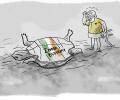
'The outlook for private investment, which has been such a weak link for India for so long, remains challenging.'
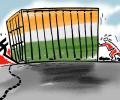
Policy discussions now should urgently focus on the road map for serious economic and institutional reforms to put India on a sustained high growth trajectory like the Chinese economy, says Jayanta Roy.

Earlier, the RBI cut its policy interest rate to 6.75 per cent.

According to a new report by international management consulting firm Arthur D Little, the worst of COVID-19's impact will be felt by India's most vulnerable in terms of job loss, poverty increase and reduced per-capita income, which in turn will result in a steep decline in the Gross Domestic Product (GDP). "Given the continued rise of COVID-19 cases, we believe that a W-shaped recovery is the most likely scenario for India. This implies a GDP contraction of 10.8 per cent in FY 2020-21 and GDP growth of 0.8 per cent in FY 2021-22," the report said.

Current account deficit is expected to narrow to 1 per cent.

The economy has shown sharp resilience in the past and has also bounced back in good time. We could hence expect a similar trajectory next year, observes Madan Sabnavis, chief economist, CARE Ratings.

The government's programmes should be expected to generate some momentum, but the macro-economic numbers are not encouraging, observes T N Ninan.

The 46-year-old chairman of the Aditya Birla Group has made at least 28 acquisitions since he took the reins of the group 18 years ago.

It blamed delay by the Reserve Bank in cutting rates and prop up growth.

Ad spends to revive in 2018; India likely to add Rs 47,028 crore in the next five years

Hailstorms may cause Rs 12k-cr crop damage, El Nino a bigger worry.

The UN World Economic Situation and Prospects 2014 report said a mild recovery in investment as well as stronger export growth will help in the gradual GDP pick-up.

The Reserve Bank on Wednesday hiked key benchmark policy rate by 25 basis points to 6.5 per cent, citing sticky core inflation. This is the sixth time interest rate has been hiked by the Reserve Bank of India (RBI) since May last year, taking the total quantum of hike to 250 basis points. Announcing the bi-monthly monetary policy, RBI Governor Shaktikanta Das said the Monetary Policy Committee (MPC) by a majority decided to raise the policy repo rate by 25 basis points and keep a 'strong vigil' on inflation outlook.

Pakistan was "drowning" in debt and it was the new government's job to "sail this ship ashore," Prime Minister Shehbaz Sharif said on Wednesday.

On the rupee, it expects some appreciation pressure on in the near term from greater portfolio flows.

The number of billionaires in China has touched 300 by the end of 2013 mainly due to real estate boom, according to a new annual ranking of the wealthiest individuals in the communist nation, world's second largest economy.

India's economic growth is likely to reach pre-COVID-19 levels by the end of the 2021-22 fiscal as the GDP contraction in this financial year is expected to be less than 8 per cent, Niti Aayog vice chairman Rajiv Kumar said on Sunday. The Reserve Bank of India (RBI) has also revised its forecast of economic growth for the current fiscal year (2020-21) to (-)7.5 per cent as against its earlier forecast of (-)9.5 per cent.

Being one of the early commentators to flag economic slowdown and caution investors on corporate earnings, Gautam Chhaochharia, head of India research, UBS Securities, in an interview with Hamsini Karthik says the markets remain in an expensive zone despite the recent correction.

Given the various risks to growth, one could argue for rate cuts to be deeper than the 5 per cent terminal repo rate that we are projecting at this stage, says Kaushik Das.

Sensex firm on favourable GDP numbers for FY16.

Economist Abheek Barua's insight into the global and domestic economy at the turn of the financial year.

The GST will subsume excise, service tax, value added tax, octroi etc.
